Contract Testing for Internal APIs


Table of Contents
When Service A depends on Service B’s API, how do you ensure changes to B don’t break A? Integration tests are slow and can be flaky. Documentation drifts from reality within weeks. Manual coordination between teams doesn’t scale past a handful of services.
I’ve seen this play out more than once. A User Service team ships what they consider a minor change: renaming userId to user_id in their response payload to match their new coding standards. They updated their OpenAPI spec. They ran their own tests. Everything passed.
Three services broke in production.
The Order Service, Shipping Service, and Analytics Service all consumed that field. Nobody had checked with them. The OpenAPI spec was correct for the new behavior, but the consumers were still expecting the old field name. The deployment happened on a Friday afternoon. The on-call engineer spent the weekend coordinating rollbacks and emergency patches.
Contract testing would have caught this at PR time. Before the User Service merge, automated tests would have run against the actual consumer expectations, not just the provider’s idea of what consumers need. The build would have failed with a clear message: “OrderService expects field ‘userId’, but response contains ‘user_id’.”
Consumer-driven contracts flip the traditional testing model. Instead of the provider defining what it offers and hoping consumers adapt, consumers define what they need and providers verify they can deliver it. The contract becomes a shared artifact that both sides test against, ensuring compatibility before code leaves the developer’s machine.
Consumer-driven contracts catch breaking changes at PR time, not in production. The provider can’t ship changes that break consumers because the consumer’s expectations are encoded in automated tests.
The Problem with Traditional Integration Testing
The instinct when services start breaking is to add more integration tests. If Service A calling Service B fails in production, write a test that spins up both services and verifies the call works. Problem solved, right?
This approach collapses under its own weight as services multiply.
Why Integration Tests Fail at Scale
Integration tests require all services to be running simultaneously. For a simple three-service chain, that means coordinating databases, message queues, and network connectivity across all three. Add a fourth service, and the coordination overhead grows. By the time you have 20 services, the “integration test environment” has become a full-time job for someone on the platform team.
The problems compound from there. Shared test databases accumulate garbage data from previous runs, causing tests to fail for reasons unrelated to the code change. Port conflicts appear when two developers run tests simultaneously. Network timeouts introduce flakiness that erodes trust in the test suite. Developers stop running integration tests locally because they take too long, pushing the feedback loop to CI where it’s even slower.
When an integration test fails, debugging becomes archaeology. A failure in Service X might be caused by a change in Service Y, but the stack trace only shows where the exception was thrown, not where the problem originated. Reproducing the failure locally requires spinning up the entire environment, which often behaves differently than CI.
| # | Testing Approach | Speed | Reliability | Isolation | Catches Breaking Changes |
|---|---|---|---|---|---|
| 1 | Unit tests | Fast | High | Complete | No (mocks hide reality) |
| 2 | Integration tests | Slow | Low | None | Yes (but late) |
| 3 | E2E tests | Very slow | Very low | None | Yes (in production-like) |
| 4 | Contract tests | Fast | High | Complete | Yes (at PR time) |
The fundamental problem is that integration tests conflate two concerns: verifying that your code works correctly, and verifying that your code is compatible with its dependencies. Contract tests separate these concerns. Unit tests verify correctness. Contract tests verify compatibility. Neither requires spinning up the entire world.
The Documentation Lie
Teams often try to solve the compatibility problem with documentation. “We’ll maintain an OpenAPI spec, and consumers will code against it.” This works for about three months.
# What the OpenAPI spec says
paths:
  /users/{id}:
    get:
      responses:
        200:
          content:
            application/json:
              schema:
                type: object
                properties:
                  userId:      # Spec says userId
                    type: string
                  email:
                    type: string

# What the implementation actually returns
# {
#   "user_id": "123",  # Implementation uses user_id
#   "email": "test@example.com"
# }

# The spec was written once and never updated
# Consumers who trusted the spec are now brokenThe spec was written when the API was first built. Six months later, someone refactored the response format to match a new coding standard. They updated the code, ran the tests, and shipped. The OpenAPI spec stayed frozen in time because updating it was “on the backlog.” Consumers who built against the documented spec are now broken.
Documentation without enforcement is fiction. Schemas describe intent; contract tests verify reality.
Consumer-Driven Contracts Explained
The Core Concept
Traditional API testing puts the provider in charge. The provider defines a schema, publishes documentation, and consumers build against it. If the provider changes the API, consumers find out when their code breaks — often in production.
Consumer-driven contracts invert this model. The consumer defines what it needs from the provider and encodes those expectations in a contract. The provider then verifies it can satisfy that contract. Both sides test against the same artifact, so compatibility is verified before either side deploys.
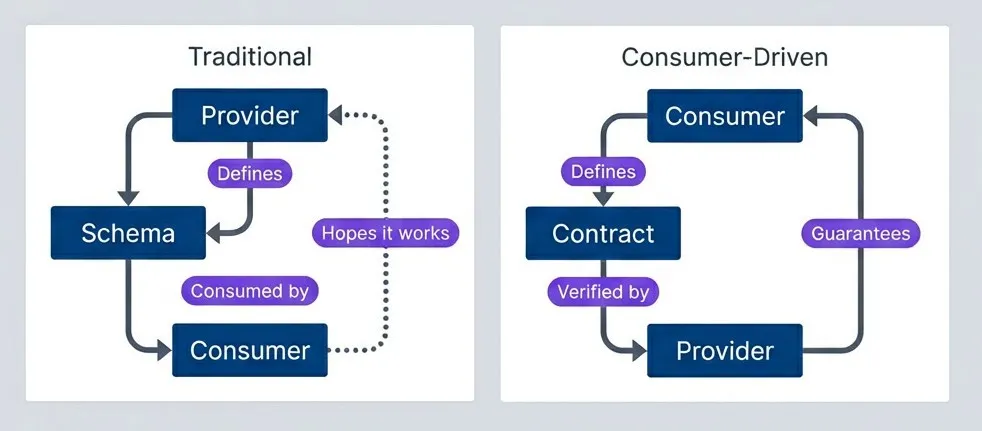
Traditional vs consumer-driven contract modeldescription
Flowchart comparing the traditional model, where a provider defines a schema that the consumer uses and hopes stays accurate, with the consumer-driven model, where the consumer defines a contract that the provider verifies before deployment.
The flow works like this: First, the consumer writes a test that defines its expectations. “When I call GET /users/123, I expect a response with a userId string and an email string.” That test generates a contract file describing the expected interaction.
The contract gets stored somewhere accessible to the provider — usually a Pact Broker, though a file share or git repository works for simpler setups. The provider then runs verification tests that fetch these contracts and replay the interactions against the real implementation. If the provider’s response doesn’t match what the consumer expects, the test fails.
Pact is the most widely adopted tool for consumer-driven contract testing. The project includes language-specific libraries for writing contract tests, a mock server for consumer testing, and the Pact Broker — an open-source registry for storing and versioning contracts. We’ll dive deep into Pact’s architecture and usage in the next section.
The key insight is that both sides now have a shared source of truth. The consumer knows the provider will deliver what it needs because the provider’s CI pipeline verifies it. The provider knows exactly which fields each consumer depends on, making it safe to change or remove anything that isn’t in a contract.
What Goes in a Contract
Contracts should test API shape, not business logic. This distinction trips up teams new to contract testing.
A contract verifies structure: the request path, HTTP method, required headers, response status code, and the shape of the response body. It answers questions like “does the response have a userId field that’s a string?” and “does a 404 response include an error object?”
A contract does not verify business logic: it shouldn’t check that user 123 has a specific email address, or that creating a user with duplicate email returns a particular error message. Those are integration test concerns. The consumer shouldn’t know or care about the provider’s database state.
| In Scope | Out of Scope |
|---|---|
| Request path and method | Specific data values |
| Required headers | Database state |
| Response status codes | Exact error messages |
| Response body structure | Performance characteristics |
| Field types (string, number, array) | Security rules |
This boundary keeps contracts stable. Business logic changes frequently — error messages get reworded, validation rules evolve, edge cases get handled differently. API structure changes rarely, and when it does, it’s usually a breaking change that consumers need to know about.
Contract tests verify the API contract, not business logic. They answer “does the response have a userId field that’s a string?” not “does user 123 exist?”
Who Drives API Evolution?
The name “consumer-driven contracts” raises an obvious question: if consumers drive the contracts, who drives the API? Are consumer teams dictating the provider’s backlog? How do API developers evolve their services if they don’t control what they’re implementing?
The short answer: “consumer-driven” describes where contracts come from, not who designs the API.
Providers Still Design the API
Provider teams design, implement, and evolve their APIs exactly as they always have. They decide endpoint structure, field names, data types, versioning strategy — all of it. Consumer-driven contracts don’t change that.
What changes is visibility. Before CDC, a provider team might rename a field and discover three weeks later (in a staging environment, or worse, production) that two other services depended on the old name. With CDC, they discover it immediately: the contract tests fail, the Pact Broker shows exactly which consumers use that field, and the conversation happens before any code deploys.
The Workflow for API Changes
API evolution follows one of two patterns depending on whether the change is additive or breaking:
Additive changes (new endpoints, new optional fields) require no coordination. Providers add the capability, deploy it, and consumers adopt it when ready. As consumers start using the new feature, they add interactions to their contracts. The provider already satisfies these contracts — that’s what “additive” means.
Breaking changes (removing fields, renaming fields, changing types) trigger a conversation. When a provider needs to make a breaking change, the workflow is:
- Provider team updates their code and runs contract verification locally
- Verification fails for consumers using the affected fields
- Pact Broker shows exactly which consumers depend on the changing contract
- Provider team coordinates with affected consumer teams
- Consumer teams update their code and contracts
- Once all consumers have migrated, the provider deploys
The diagram below shows this coordination in practice. Notice that the provider never deploys until verification passes against every affected consumer — the Pact Broker acts as the single source of truth for who depends on what.
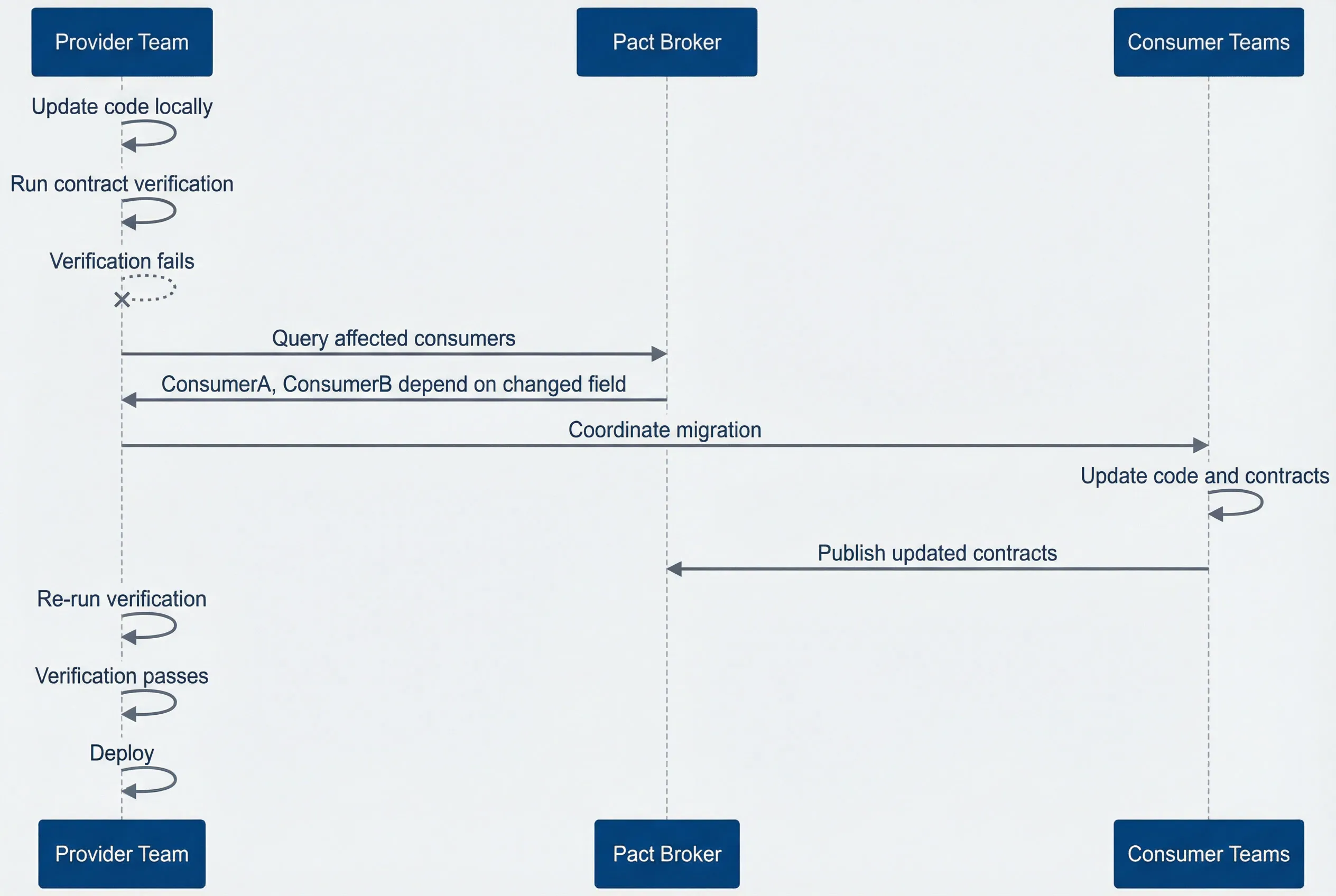
Breaking change coordination workflow with Pactdescription
Sequence diagram showing a provider team making a local change, failing contract verification, querying the Pact Broker for affected consumers, coordinating with consumer teams to update code and contracts, then rerunning verification successfully before deployment.
This isn’t providers waiting on consumers’ permission — it’s providers having evidence of who they need to coordinate with. Before CDC, step 3 was “check the wiki, ask around in Slack, hope you found everyone.” With CDC, step 3 is “query the Pact Broker.”
Contracts Capture Usage, Not Requirements
Think of consumer contracts as usage telemetry, not requirements documents. A consumer contract says “we currently call this endpoint and expect these fields.” It’s not a feature request or a demand — it’s a statement of fact about the integration.
When a consumer needs something the provider doesn’t offer, that’s a normal product conversation: file a ticket, discuss in sprint planning, negotiate priority. The consumer can even write a contract for the expected behavior before the provider implements it — Pact handles this gracefully with “pending pacts” (covered in the Scaling section).
The key mindset shift: contracts aren’t constraints that providers must satisfy. They’re visibility into what consumers actually depend on, so changes can be coordinated instead of hoped-for.
Pact: The De Facto Standard
Pact Architecture
Pact consists of a component you deploy and a component you run locally or in CI.
The component you deploy is the Pact Broker — a central registry that stores contracts and tracks compatibility between service versions. It’s distributed as a Docker image (pactfoundation/pact-broker) and runs as a single container backed by PostgreSQL. In Kubernetes, that’s typically a Deployment with one replica plus a database (or a managed PostgreSQL service). If you’re using GitOps with Argo CD or Flux, the broker deploys like any other stateless service. Resource requirements are modest — it’s essentially a Ruby web app with a database.
The component you run locally and in CI is the Pact library for your language. Pact has official libraries for JavaScript/TypeScript, Java, Go, Python, Ruby, .NET, and others. These libraries provide two capabilities: a mock server for consumer tests, and a verifier for provider tests.
Here’s how the pieces fit together:
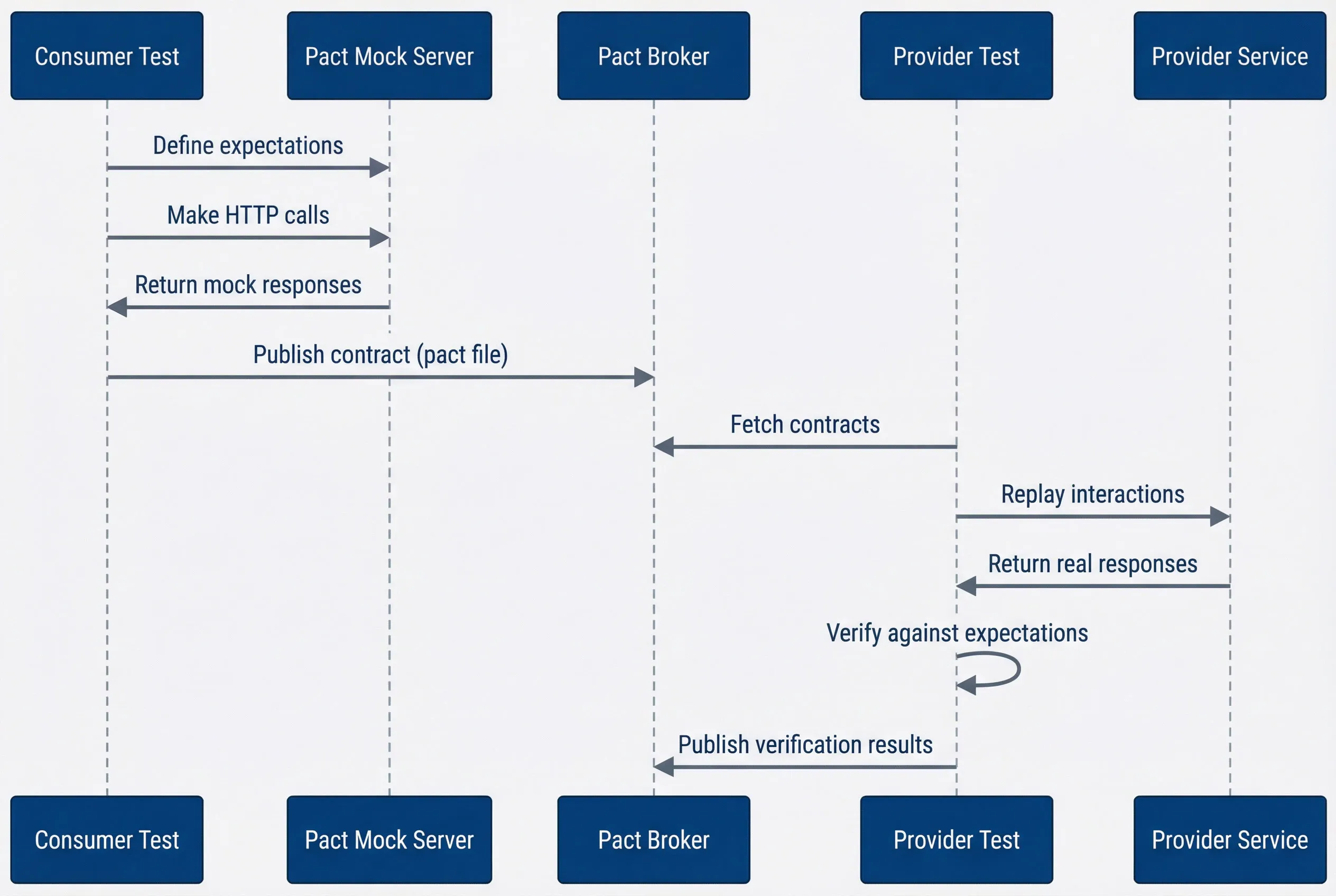
Pact workflow from consumer test to provider verificationdescription
Sequence diagram showing the consumer test defining expectations against the Pact mock server, publishing the generated contract to the Pact Broker, and the provider test fetching that contract, replaying interactions against the real provider service, verifying responses, and publishing verification results back to the broker.
On the consumer side, you write Pact tests that describe what your service expects from its dependencies. These tests run against a mock server that the Pact library spins up locally — no network calls to real services. You define the request you’ll make and the response you expect. The mock server returns that response, and your test verifies your code handles it correctly. When the test passes, Pact generates a “pact file”—a JSON document describing every interaction your consumer expects.
That pact file gets published to the Pact Broker using the pact-broker CLI, typically as an automated CI step after tests pass.
On the provider side, verification tests fetch contracts from the broker, replay each recorded interaction against the real running provider service, and compare actual responses to what consumers expect. If the provider’s response doesn’t match, the test fails. Results get published back to the broker, completing the compatibility record.
The broker’s killer feature is webhooks. When a consumer publishes a new contract, the broker can trigger the provider’s CI pipeline via webhook to run verification immediately. This closes the feedback loop: a consumer change that would break the provider gets caught within minutes, not after deployment.
Consumer Side: Writing Pact Tests
A consumer Pact test has three parts: defining what you expect, exercising your code against the mock server, and letting Pact generate the contract.
The example below shows a typical consumer test using the JavaScript/TypeScript Pact library. The OrderService (our consumer) needs to fetch user details from the UserService (the provider). Instead of calling the real UserService, the test defines what response it expects and runs against a Pact mock server.
import { PactV3, MatchersV3 } from '@pact-foundation/pact';

const { like, eachLike, regex, datetime } = MatchersV3;

const provider = new PactV3({
  consumer: 'OrderService',
  provider: 'UserService',
});

describe('User Service Contract', () => {
  it('returns user details for valid user ID', async () => {
    await provider
      .given('a user with ID 123 exists')        // Provider state
      .uponReceiving('a request for user 123')
      .withRequest({
        method: 'GET',
        path: '/users/123',
        headers: { Authorization: like('Bearer token') },
      })
      .willRespondWith({
        status: 200,
        body: {
          userId: like('123'),                   // Type matcher
          email: regex(/^\S+@\S+$/, 'a@b.com'),  // Pattern matcher
          roles: eachLike('admin'),              // Array matcher
        },
      });

    await provider.executeTest(async (mockServer) => {
      const client = new UserServiceClient(mockServer.url);
      const user = await client.getUser('123');
      expect(user.userId).toBeDefined();
    });
  });
});When this test passes, Pact generates a contract file (typically JSON) that captures the interaction:
{
  "consumer": { "name": "OrderService" },
  "provider": { "name": "UserService" },
  "interactions": [{
    "description": "a request for user 123",
    "providerState": "a user with ID 123 exists",
    "request": {
      "method": "GET",
      "path": "/users/123"
    },
    "response": {
      "status": 200,
      "body": {
        "userId": "123",
        "email": "a@b.com",
        "roles": ["admin"]
      },
      "matchingRules": {
        "body": {
          "$.userId": { "match": "type" },
          "$.email": { "match": "regex", "regex": "^\\S+@\\S+$" },
          "$.roles": { "match": "type", "min": 1 }
        }
      }
    }
  }]
}The matchingRules section is where matchers get encoded — the provider verification will use these rules rather than exact value comparison.
The .given() clause specifies a “provider state”—a precondition that the provider must set up before running verification. The provider will implement a state handler for “a user with ID 123 exists” that seeds its test database appropriately. This keeps the contract focused on structure while letting the provider control its own test data.
The .withRequest() and .willRespondWith() clauses define the contract itself. Notice the matchers like like(), regex(), and eachLike()—these are critical. Instead of asserting exact values, matchers verify types and patterns. The contract says “userId must be a string” rather than “userId must be ‘123’”. This flexibility prevents brittle tests that break when test data changes.
Inside provider.executeTest(), you exercise your real client code against the mock server. This verifies that your code actually handles the response shape you’ve defined. If your client expects user.id but the contract says userId, the test fails here — before you ever publish the contract.
Understanding Pact Matchers
Matchers are what make contracts flexible instead of brittle. Without matchers, you’d be asserting exact values: “userId must equal ‘123’”. That breaks as soon as the provider uses different test data. Matchers let you assert types and patterns instead: “userId must be a string.”
Every matcher serves a dual purpose. During consumer tests, the example value gets returned by the mock server so your code has realistic data to work with. During provider verification, the matcher rule gets applied to the actual response to verify it conforms to the contract.
import { MatchersV3 } from '@pact-foundation/pact';

const {
  like,           // Type matching
  eachLike,       // Array with type matching
  regex,          // Regex pattern matching
  datetime,       // DateTime format matching
  integer,        // Integer type
  decimal,        // Decimal type
  boolean,        // Boolean type
  string,         // String type
  nullValue,      // Null value
  uuid,           // UUID format
  email,          // Email format
  ipv4Address,    // IPv4 format
} = MatchersV3;

// Examples
const matcherExamples = {
  // like(): Match type, use example for mock
  userId: like('abc-123'),
  // Contract: must be a string
  // Mock returns: 'abc-123'

  // eachLike(): Array where each item matches type
  items: eachLike({
    id: like('item-1'),
    price: decimal(19.99),
  }),
  // Contract: array of objects with id (string) and price (decimal)
  // Mock returns: [{ id: 'item-1', price: 19.99 }]

  // regex(): Match against pattern
  status: regex(/^(pending|completed|failed)$/, 'pending'),
  // Contract: must match regex
  // Mock returns: 'pending'

  // Nested matching
  metadata: like({
    createdAt: datetime("yyyy-MM-dd'T'HH:mm:ss'Z'"),
    updatedBy: like('user-123'),
    tags: eachLike('important'),
  }),
};The table below summarizes the most commonly used matchers. In practice, like() handles 80% of cases — use it as your default and reach for more specific matchers when you need tighter validation.
| Matcher | Use Case | Contract Meaning |
|---|---|---|
| like(example) | Most fields | Same type as example |
| eachLike(example) | Arrays | Array with items of same type |
| regex(pattern, example) | Enums, formats | Must match regex |
| datetime(format) | Timestamps | Valid datetime in format |
| integer(example) | Counts, IDs | Integer number |
| decimal(example) | Prices, rates | Decimal number |
| uuid() | Identifiers | Valid UUID format |
Matchers are the key to maintainable contracts. Use like() for most fields — it verifies structure without coupling to specific values.
Provider Side: Verification
Provider verification is the other half of the contract testing loop. While consumer tests generate contracts, provider tests verify the real service can satisfy them.
The verification process works like this: the Pact verifier fetches contracts from the broker (or reads them from local files), replays each interaction against your running service, and compares actual responses to the contract expectations. If all matchers pass, the verification succeeds. If any response doesn’t match, you get a detailed diff showing exactly what went wrong.
import { Verifier } from '@pact-foundation/pact';
import { app } from '../src/app';

describe('User Service Provider Verification', () => {
  let server: Server;

  beforeAll(async () => {
    // Provider service port (not the Pact Broker port 9292)
    server = app.listen(3001);
  });

  afterAll(async () => {
    server.close();
  });

  it('validates the expectations of OrderService', async () => {
    const verifier = new Verifier({
      provider: 'UserService',
      providerBaseUrl: 'http://localhost:3001',

      // Pact Broker configuration
      pactBrokerUrl: process.env.PACT_BROKER_URL,
      pactBrokerToken: process.env.PACT_BROKER_TOKEN,

      // Or local pact files
      // pactUrls: ['./pacts/orderservice-userservice.json'],

      // Provider states setup
      stateHandlers: {
        'a user with ID 123 exists': async () => {
          await seedDatabase({
            users: [{ id: '123', email: 'user@example.com', name: 'John Doe' }],
          });
        },
        'no user with ID 999 exists': async () => {
          await clearDatabase();
        },
      },

      // Publish results
      publishVerificationResult: true,
      providerVersion: process.env.GIT_COMMIT_SHA,
      providerVersionBranch: process.env.GIT_BRANCH,
    });

    await verifier.verifyProvider();
  });
});The stateHandlers object is where you implement the provider states that consumers reference in their .given() clauses. When the verifier encounters a contract with .given('a user with ID 123 exists'), it calls your state handler to set up the test data before replaying that interaction. This keeps test data management on the provider side where it belongs — the consumer just declares what precondition it needs.
The publishVerificationResult flag tells Pact to report results back to the broker, completing the compatibility matrix. The providerVersion should be your git commit SHA so you can track exactly which code version verified which contracts.
Provider States
Provider states bridge the gap between contracts and test data. A contract says “when I request user 123, I expect these fields.” But where does user 123 come from? The provider needs to set that up — and that’s what state handlers do.
const stateHandlers: StateHandlers = {
  'a user exists': async () => {
    await db.users.create({ id: 'test-user', email: 'test@example.com' });
  },

  'a user with ID {id} exists': async (params) => {
    await db.users.create({
      id: params.id,
      email: `user-${params.id}@example.com`,
    });
  },

  // State with cleanup
  'the system has no users': async () => {
    await db.users.deleteAll();
    return () => {
      // Teardown function (optional)
      console.log('Cleaned up empty state');
    };
  },

  'user {userId} has {count} orders': async (params) => {
    // Parameterized state with multiple entities
    const user = await db.users.create({ id: params.userId });
    for (let i = 0; i < params.count; i++) {
      await db.orders.create({ userId: user.id, orderId: `order-${i}` });
    }
  },
};State handlers support three patterns. Simple states like 'a user exists' take no parameters — they set up a known fixture. Parameterized states like 'a user with ID {id} exists' extract values from the state description, letting consumers specify exact IDs when they need predictable responses. Complex states combine multiple parameters to set up richer scenarios.
The naming convention matters. When a consumer writes .given('a user with ID 123 exists'), Pact matches it against your 'a user with ID {id} exists' handler and passes { id: '123' } as the params object. Keep state descriptions readable — they show up in the Pact Broker UI and serve as documentation.
Provider states should be minimal — just enough to satisfy the contract. Don’t build elaborate fixtures; contract tests verify structure, not business logic.
Schema-Based Alternatives
Not every team needs Pact. Schema-based approaches offer simpler tooling when you don’t need the full consumer-driven workflow — especially for public APIs with unknown consumers or teams already maintaining OpenAPI specifications.
OpenAPI-Based Contract Testing
OpenAPI-based tools flip the script: instead of consumers generating contracts, you maintain a specification and validate both sides against it. Several tools take your OpenAPI spec and generate tests automatically:
- Prism (from Stoplight)
- Acts as a mock server and validation proxy. Point it at your OpenAPI spec and it validates requests/responses in real-time.
- Dredd
- Generates and runs tests from your spec, comparing actual API responses to documented examples.
- Schemathesis
- Takes a property-based testing approach, generating hundreds of test cases from your schema to find edge cases.
These tools work well when you already maintain an OpenAPI spec and want to catch drift between the spec and the implementation. But they test against the specification, not against what consumers actually depend on. The table below compares the trade-offs across approaches.
| Approach | Contract Source | Strengths | Weaknesses |
|---|---|---|---|
| Pact CDC | Consumer tests | Tests actual consumer needs; fine-grained matchers; built-in broker | Requires buy-in from all teams; learning curve |
| OpenAPI tools | OpenAPI specification | Uses existing specs; simpler mental model | Specs drift from reality; tests provider, not consumer needs |
| GraphQL Schema | GraphQL schema | Schema is the contract; breaking change detection | GraphQL-specific |
The fundamental difference: Pact tests what consumers actually use, while schema-based tools test what the specification says. If your spec is always accurate and complete, schema-based works great. If your spec drifts (as specs often do), you’re testing against documentation, not reality.
When to Use Each Approach
The decision tree is simpler than it looks: if you know your consumers and can coordinate with them, Pact pays dividends. If you’re building a public API or can’t get consumer teams to write tests, schema-based is more practical.
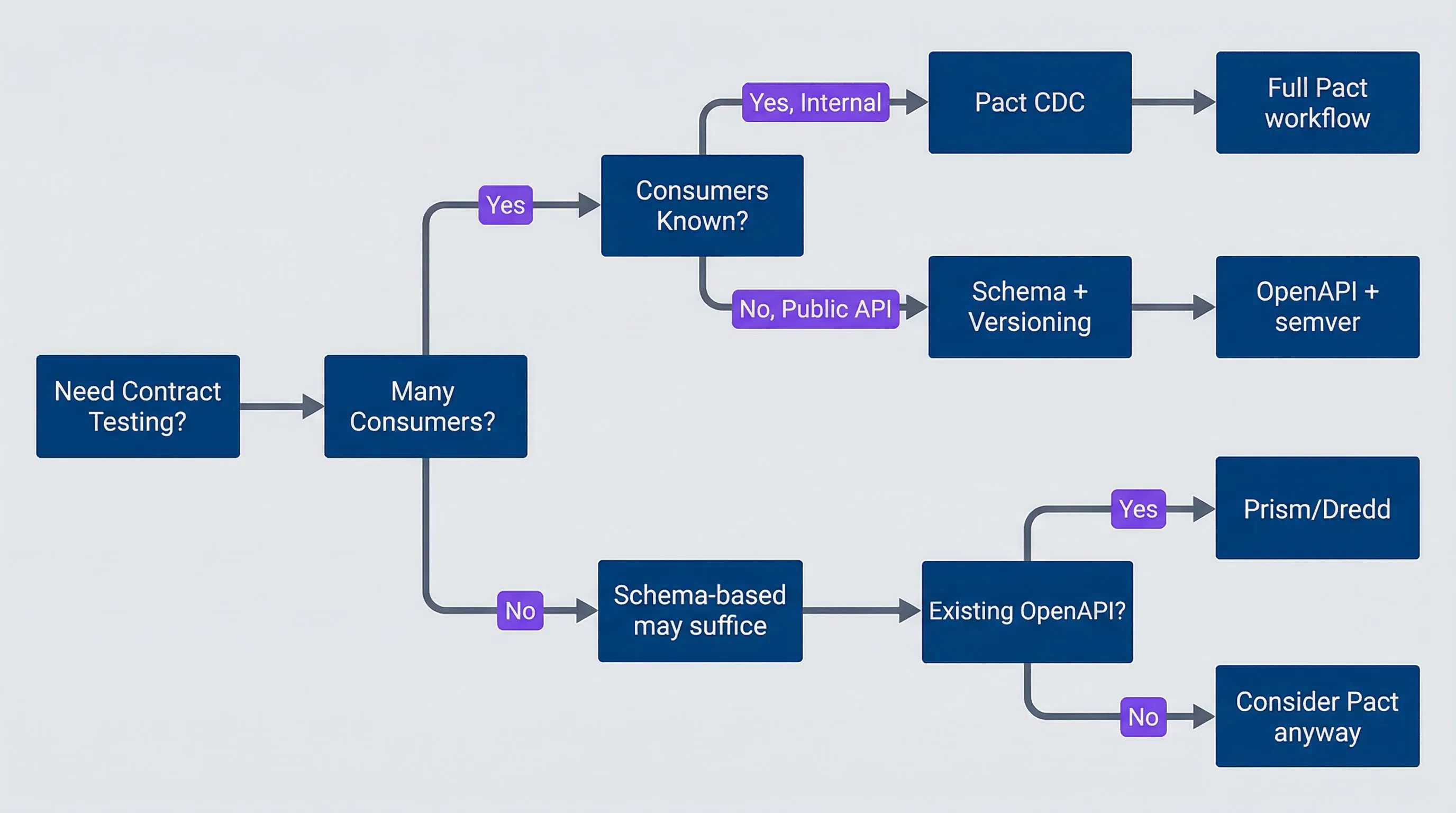
Decision tree for choosing contract testing approachdescription
Flowchart guiding teams through contract testing choices based on the number of consumers, whether consumers are known, and whether an OpenAPI specification already exists, ending with recommendations such as Pact CDC, schema plus versioning, Prism or Dredd, or the full Pact workflow.
For a quick reference, the table below pairs typical architectural and team scenarios with their ideal testing approach.
| Scenario | Recommended Approach |
|---|---|
| Internal microservices, known consumers | Pact CDC |
| Public API, unknown consumers | OpenAPI + semantic versioning |
| GraphQL API | GraphQL schema + Apollo Studio |
| Small team, few services | Pact or schema-based both work |
| Large org, many teams | Pact with Pact Broker |
| Legacy API, can't change provider | Schema-based validation only |
For most internal microservice architectures, Pact is the stronger choice. It catches the exact breaking changes that affect your specific consumers — not theoretical breakages based on a spec that might be outdated.
CI/CD Integration
Contract testing delivers value when it’s wired into your deployment pipeline. The goal: make it impossible to deploy incompatible services. This section shows how to set up Pact Broker, configure consumer and provider pipelines, and use can-i-deploy as your deployment gate.
Pact Broker Setup
If you’re running locally or want a quick Docker Compose setup for development, here’s a minimal configuration. For production, you’d typically deploy this to Kubernetes (as shown in the Architecture section) with proper secrets management.
services:
  postgres:
    image: postgres:15
    environment:
      POSTGRES_USER: pact
      POSTGRES_PASSWORD: pact
      POSTGRES_DB: pact
    volumes:
      - pact-db:/var/lib/postgresql/data

  pact-broker:
    image: pactfoundation/pact-broker:latest
    ports:
      - "9292:9292"
    environment:
      PACT_BROKER_DATABASE_URL: "postgres://pact:pact@postgres/pact"
      PACT_BROKER_BASIC_AUTH_USERNAME: admin
      PACT_BROKER_BASIC_AUTH_PASSWORD: admin
      PACT_BROKER_ALLOW_PUBLIC_READ: "true"
    depends_on:
      - postgres

volumes:
pact-db:This gives you a running broker at http://localhost:9292. The PACT_BROKER_ALLOW_PUBLIC_READ setting lets you browse contracts without authentication — useful for development, but disable it in production.
Consumer CI Pipeline
Consumer pipelines do three things: run contract tests (generating pact files), publish those pacts to the broker, and check if deployment is safe. The publish step tags contracts with the git SHA and branch, so the broker knows exactly which code version created each contract.
# .github/workflows/consumer-ci.yaml
name: Consumer CI

on: [push, pull_request]

jobs:
  test:
    runs-on: ubuntu-latest
    steps:
      - uses: actions/checkout@v4

      - name: Run unit tests
        run: npm test

      - name: Run contract tests
        run: npm run test:contract
        env:
          PACT_BROKER_URL: ${{ secrets.PACT_BROKER_URL }}
          PACT_BROKER_TOKEN: ${{ secrets.PACT_BROKER_TOKEN }}

      - name: Publish contracts
        if: github.ref == 'refs/heads/main'
        run: |
          npx pact-broker publish ./pacts \
            --consumer-app-version=${{ github.sha }} \
            --branch=${{ github.ref_name }} \
            --broker-base-url=${{ secrets.PACT_BROKER_URL }} \
            --broker-token=${{ secrets.PACT_BROKER_TOKEN }}

      - name: Can I Deploy?
        run: |
          npx pact-broker can-i-deploy \
            --pacticipant=OrderService \
            --version=${{ github.sha }} \
            --to-environment=production \
            --broker-base-url=${{ secrets.PACT_BROKER_URL }} \
--broker-token=${{ secrets.PACT_BROKER_TOKEN }}The can-i-deploy check at the end queries the broker’s compatibility matrix. If the provider hasn’t verified this consumer version yet (or verification failed), the check fails and blocks deployment. This is the safety net that prevents deploying consumers that would break against production providers.
Provider CI Pipeline
Provider pipelines verify contracts and report results back to the broker. The key difference from consumer pipelines: providers listen for webhook events. When a consumer publishes a new contract, the broker can trigger the provider’s CI to verify immediately — no waiting for the next scheduled build.
# .github/workflows/provider-ci.yaml
name: Provider CI

on:
  push:
  pull_request:
  # Webhook from Pact Broker when new contracts published
  repository_dispatch:
    types: [pact-contract-published]

jobs:
  verify:
    runs-on: ubuntu-latest
    steps:
      - uses: actions/checkout@v4

      - name: Run unit tests
        run: npm test

      - name: Verify contracts
        run: npm run test:contract:verify
        env:
          PACT_BROKER_URL: ${{ secrets.PACT_BROKER_URL }}
          PACT_BROKER_TOKEN: ${{ secrets.PACT_BROKER_TOKEN }}
          GIT_COMMIT_SHA: ${{ github.sha }}
          GIT_BRANCH: ${{ github.ref_name }}

      - name: Can I Deploy?
        run: |
          npx pact-broker can-i-deploy \
            --pacticipant=UserService \
            --version=${{ github.sha }} \
            --to-environment=production \
            --broker-base-url=${{ secrets.PACT_BROKER_URL }} \
--broker-token=${{ secrets.PACT_BROKER_TOKEN }}The repository_dispatch trigger is how Pact Broker webhooks reach GitHub Actions. Configure the webhook in the broker to POST to https://api.github.com/repos/{owner}/{repo}/dispatches with the event type pact-contract-published. This creates a tight feedback loop: consumer publishes contract → broker triggers provider CI → verification results appear within minutes.
The can-i-deploy command is the key to safe deployments. It checks if the current version is compatible with all services in the target environment before allowing deployment.
The Can-I-Deploy Flow
The can-i-deploy command ties everything together. It queries the Pact Broker’s compatibility matrix to determine if a specific version of a service can safely deploy to a target environment. The broker tracks which versions are deployed where, and which contracts have been verified — so it can answer “will this deployment break anything?” with certainty.
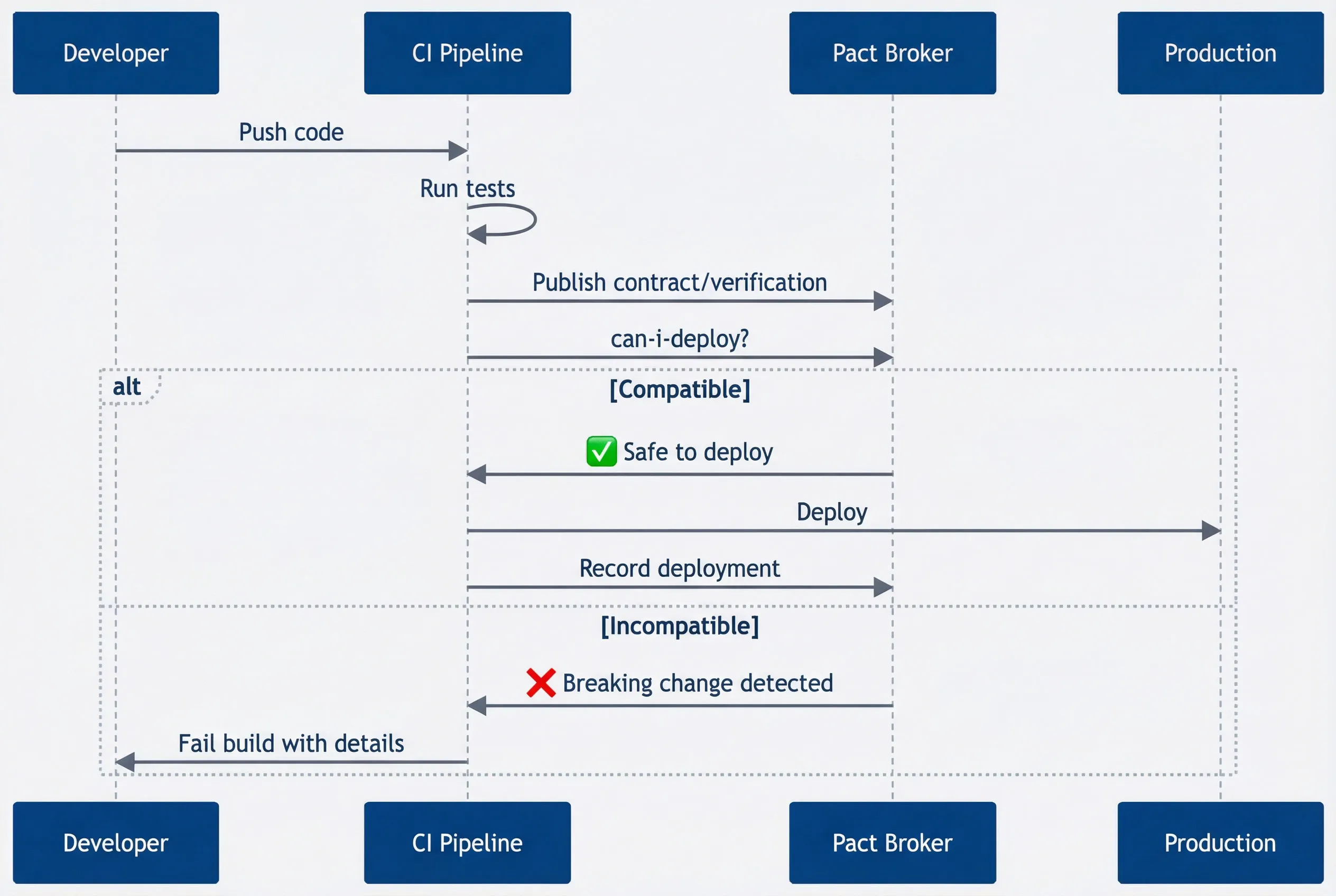
Can-I-Deploy flow preventing incompatible deploymentsdescription
Sequence diagram showing a developer pushing code to CI, CI running tests, publishing contracts or verification results to the Pact Broker, and querying can-i-deploy. If compatibility checks pass, CI deploys to production and records the deployment; if they fail, the build stops and the developer gets a breaking change notice.
When can-i-deploy passes, the pipeline records the deployment with pact-broker record-deployment. This updates the broker’s view of what’s running in each environment, so future compatibility checks are accurate. The entire flow — publish, verify, check, deploy, record — creates an audit trail of every service version that ever ran in production.
Test Organization
As your service count grows, so does your contract test surface. A three-service system has manageable complexity; a twenty-service system can drown in test files if you don’t establish conventions early. This section covers project structure and maintainability patterns.
Structuring Contract Tests
Keep contract tests separate from unit tests — they serve different purposes and often have different dependencies. The recommended structure puts contract tests in their own directory with shared setup extracted into common files.
Project Structure:
The pacts/ directory holds generated JSON files and should be gitignored — these are build artifacts, not source code. One contract file per provider keeps things organized: user-service.pact.ts contains all interactions with the User Service, regardless of how many endpoints you call.
Extract shared configuration into a setup file that all contract tests import:
// test/contract/pact.setup.ts
import { PactV3 } from '@pact-foundation/pact';
import { resolve } from 'path';

export function createPactProvider(providerName: string): PactV3 {
  return new PactV3({
    consumer: process.env.PACT_CONSUMER || 'OrderService',
    provider: providerName,
    dir: resolve(__dirname, '../../pacts'),
    logLevel: process.env.PACT_LOG_LEVEL || 'warn',
  });
}

// Shared matchers for consistency
export const commonMatchers = {
  timestamp: () => datetime("yyyy-MM-dd'T'HH:mm:ss.SSS'Z'"),
  uuid: () => regex(
    /^[0-9a-f]{8}-[0-9a-f]{4}-[0-9a-f]{4}-[0-9a-f]{4}-[0-9a-f]{12}$/,
    'a1b2c3d4-e5f6-7890-abcd-ef1234567890'
  ),
  email: () => regex(
    /^[\w.-]+@[\w.-]+\.\w+$/,
    'user@example.com'
  ),
};The commonMatchers object is where you’ll see the biggest maintainability wins. When every contract test defines its own UUID regex, you get subtle inconsistencies. When they all import from a shared file, you change the pattern once and it propagates everywhere.
Keeping Tests Maintainable
Contract tests accumulate technical debt like any other code. These guidelines keep the debt manageable:
| Guideline | Why It Matters |
|---|---|
| One interaction per test | Easier to debug; clearer failure messages |
| Use matchers, not literals | Contracts verify structure, not specific data |
| Minimal provider states | Contract tests aren't integration tests |
| Share common patterns | Consistency across contracts |
| Version contracts with code | Contract changes = code changes |
| Review generated pacts | Catch overly specific or missing matchers |
The “one interaction per test” rule deserves emphasis. When a test file has ten interactions in a single describe block, failures become cryptic. When each interaction is its own test case, the failure message tells you exactly which API call broke.
Contract test suites grow with your service dependencies. Without organization, you’ll end up with hundreds of similar tests. Extract patterns, use shared setup, and review periodically for redundancy.
Common Pitfalls
Contract testing has a learning curve. Teams new to Pact often make the same mistakes — over-specifying contracts, ignoring error cases, or building elaborate provider states. Here’s how to avoid the most common traps.
Testing Too Much
The most frequent mistake: treating contract tests like integration tests. Contract tests verify API shape, not business logic. When you hard-code exact values instead of using matchers, you create brittle tests that break whenever test data changes — even though the API contract is perfectly stable.
// ❌ BAD: Over-specified contract
await provider
  .uponReceiving('get user')
  .withRequest({
    method: 'GET',
    path: '/users/123',
  })
  .willRespondWith({
    status: 200,
    body: {
      userId: '123',                    // Exact value!
      email: 'john@example.com',        // Exact value!
      name: 'John Doe',                 // Exact value!
      createdAt: '2024-01-15T10:30:00Z', // Exact value!
    },
  });
// This test is brittle - any data change breaks it

// ✅ GOOD: Properly specified contract
await provider
  .uponReceiving('get user')
  .withRequest({
    method: 'GET',
    path: regex(/^\/users\/\d+$/, '/users/123'),
  })
  .willRespondWith({
    status: 200,
    body: {
      userId: like('123'),
      email: regex(/^[\w.-]+@[\w.-]+\.\w+$/, 'john@example.com'),
      name: like('John Doe'),
      createdAt: datetime("yyyy-MM-dd'T'HH:mm:ss'Z'"),
    },
  });
// This test verifies structure, not specific dataThe bad example will fail if the provider returns a different user or formats the timestamp differently. The good example passes as long as the response has the right fields with the right types — which is exactly what a consumer cares about.
Missing Error Cases
Happy path tunnel vision is the second most common pitfall. Consumers parse error responses too — they display validation messages, handle 401s by redirecting to login, retry on 503s. If your contract only covers 200 responses, you’re leaving error handling untested.
// Don't just test happy paths!
// Consumers depend on error response shapes too
describe('Error contracts', () => {
  it('handles 400 Bad Request', async () => {
    await provider
      .given('invalid request data')
      .uponReceiving('a request with invalid data')
      .withRequest({
        method: 'POST',
        path: '/users',
        body: { email: 'not-an-email' },
      })
      .willRespondWith({
        status: 400,
        body: {
          error: like('Validation failed'),
          details: eachLike({
            field: like('email'),
            message: like('Invalid email format'),
          }),
        },
      });
  });

  // test cases for handles 401 Unauthorized, etc.
});At minimum, test 400 (validation errors), 401 (authentication), 404 (not found), and any error codes your consumer explicitly handles. The contract doesn’t need to cover every possible error — just the ones where response shape matters to the consumer.
Provider State Complexity
Provider states should be the simplest possible setup that satisfies the contract. When state handlers grow complex — spinning up elaborate fixtures, seeding production-like data, managing cleanup — you’ve drifted into integration test territory.
| State Description | Problem / Implementation | |
|---|---|---|
| ❌ | "production-like database with 1000 users" | Slow, brittle, not what contract tests are for |
| ❌ | "user 123 with orders 456, 789 and payment method ending 4242" | Too specific, couples consumer to provider data model |
| ✅ | "a user exists" | Create one user with auto-generated data |
| ✅ | "user has orders" | Create user with 2 generic orders |
| ✅ | "unauthorized" | No setup needed, just don't auth |
If your state handler takes more than 5 lines, question whether you’re testing the right thing. Contract tests verify “given X exists, the API returns this shape.” They don’t verify “given a complex business scenario, the API behaves correctly”—that’s what integration and E2E tests are for.
Scaling Contract Testing
Contract testing shines at scale. While integration test complexity grows quadratically with service count (every service potentially talks to every other service), contract test complexity grows linearly (each service maintains contracts with its direct dependencies). But scaling requires deliberate strategies.
Managing Many Contracts
The Pact Broker becomes your central nervous system for contract management. It tracks every contract, every verification, and every deployment across your entire service mesh.
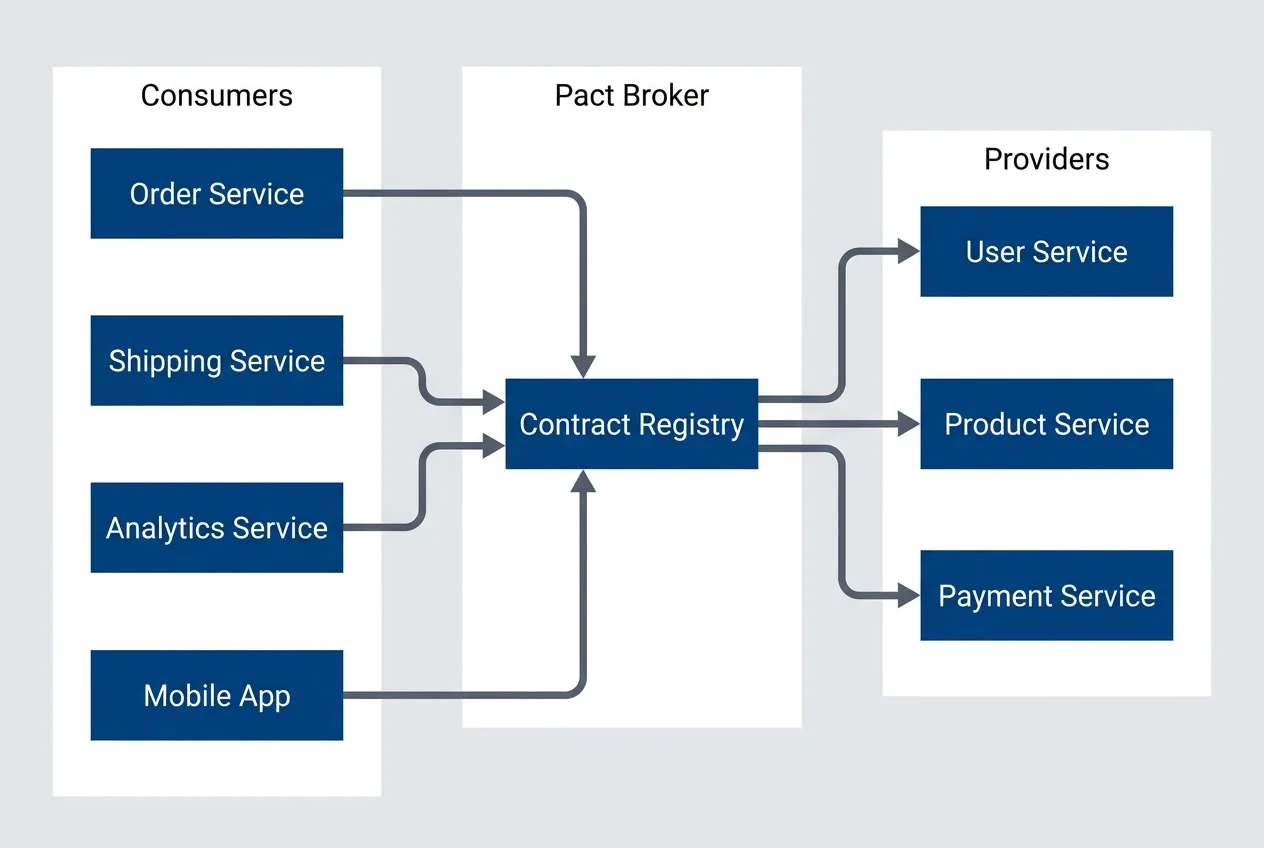
Contract testing at scale with Pact Broker as central registrydescription
Flowchart showing multiple consumer services publishing contracts into a central Pact Broker registry, which then serves those contracts to multiple provider services for verification and compatibility tracking.
As services multiply, you’ll need these scaling strategies:
| # | Strategy | What It Does |
|---|---|---|
| 1 | Environment management | record-deployment tracks which versions run where, so can-i-deploy knows what to check against |
| 2 | Webhook triggers | Auto-trigger provider verification when consumers publish new contracts — no waiting for scheduled builds |
| 3 | Pending pacts | New contracts don't fail provider builds until providers explicitly support them |
| 4 | WIP pacts | Include work-in-progress contracts in verification for early feedback |
| 5 | Matrix view | Pact Broker UI visualizes compatibility across all services at a glance |
The pending pacts feature deserves special attention. Without it, adding a new consumer interaction immediately breaks the provider build — even before the provider team knows about the change. With pending pacts enabled, new contracts are “pending” until the provider verifies them at least once. This gives provider teams time to implement support without blocking consumer development.
Pending pacts prevent the “chicken and egg” problem: new consumers can publish contracts without breaking provider builds, while providers gradually add support.
Beyond HTTP
Contract testing isn’t limited to REST APIs. Pact supports gRPC and asynchronous messaging, covering the full spectrum of service communication patterns.
gRPC Contract Testing
For gRPC services, Pact V4 uses a plugin system to handle Protocol Buffers. The contract captures the same consumer expectations — just expressed in terms of protobuf messages rather than JSON.
import { PactV4 } from '@pact-foundation/pact';

const provider = new PactV4({
  consumer: 'OrderService',
  provider: 'UserService',
  pluginDir: './pact-plugins',
});

describe('UserService gRPC Contract', () => {
  it('returns user for GetUser', async () => {
    await provider
      .usingPlugin('protobuf')
      .given('user 123 exists')
      .uponReceiving('GetUser request')
      .withPluginContents({
        'pact:proto': './protos/user_service.proto',
        'pact:content-type': 'application/grpc',
        request: { user_id: matching(type, '123') },
        response: {
          user_id: matching(type, '123'),
          email: matching(regex, /^.+@.+$/, 'user@example.com'),
        },
      })
      .executeTest(async (mockServer) => {
        const client = new UserServiceClient(mockServer.url);
        const user = await client.getUser('123');
        expect(user.email).toContain('@');
      });
  });
});Event-Driven Contracts
For message queues and event buses, Pact’s MessageConsumerPact tests asynchronous contracts. The consumer defines what message shape it expects; the provider verifies it publishes messages matching that shape.
import { MessageConsumerPact, synchronousBodyHandler } from '@pact-foundation/pact';

const messagePact = new MessageConsumerPact({
  consumer: 'OrderService',
  provider: 'UserService',
  dir: './pacts',
});

describe('User Created Event Contract', () => {
  it('handles user.created event', async () => {
    await messagePact
      .given('a new user is created')
      .expectsToReceive('a user.created event')
      .withContent({
        eventType: 'user.created',
        data: {
          userId: like('123'),
          email: like('new@example.com'),
          timestamp: datetime("yyyy-MM-dd'T'HH:mm:ss'Z'"),
        },
      })
      .verify(synchronousBodyHandler(async (message) => {
        const handler = new UserCreatedHandler();
        await handler.handle(message);
      }));
  });
});The same principles apply: consumers define expectations, providers verify they can deliver, and the Pact Broker tracks compatibility. Whether your services communicate via HTTP, gRPC, or message queues, contract testing catches breaking changes before deployment.
Conclusion
Consumer-driven contract testing solves the coordination problem that plagues microservice architectures. Instead of discovering API incompatibilities in staging (or worse, production), you catch them at PR time — before code merges, before deployment, before the Friday afternoon incident.
The key insights:
- Contracts capture what consumers actually usenot what providers think they provide. This focus on real dependencies eliminates false positives from unused fields.
- The Pact Broker is your safety net.The can-i-deploy command answers "will this deployment break anything?" with certainty, not hope.
- Contract tests verify structure, not business logic.Use matchers to specify types and patterns; leave exact values to integration tests.
- The investment scales well.While integration test complexity grows quadratically with service count, contract testing grows linearly.
Getting started is straightforward:
Getting Started Checklist
- Pick one consumer-provider pair with a stable, well-understood integration
- Write 2-3 consumer contract tests covering your most critical interactions
- Deploy Pact Broker (Docker Compose for dev, Kubernetes for production)
- Add provider verification tests with state handlers
- Wire both into CI: publish on consumer builds, verify on provider builds
- Add `can-i-deploy` checks before deployments
- Expand to additional service pairs
Once that first pair is working, expanding to other services follows the same pattern.
Contract tests are fast, reliable, and catch breaking changes at PR time. They don’t replace integration tests entirely, but they eliminate the majority of “works on my machine, breaks in production” API compatibility issues.
The team that renamed userId to user_id would have caught that breaking change in their PR checks. The deployment would have failed can-i-deploy, the compatibility matrix would have shown exactly which consumers depended on the old field name, and Friday afternoon would have stayed quiet.
Sharethisarticle
Enjoyed the read? Share it with your network.