
Release Health Gates Without Blocking Everything
Free Download
Get the ebook instantly. Review the outline, enter your work email, and open the download in one step.
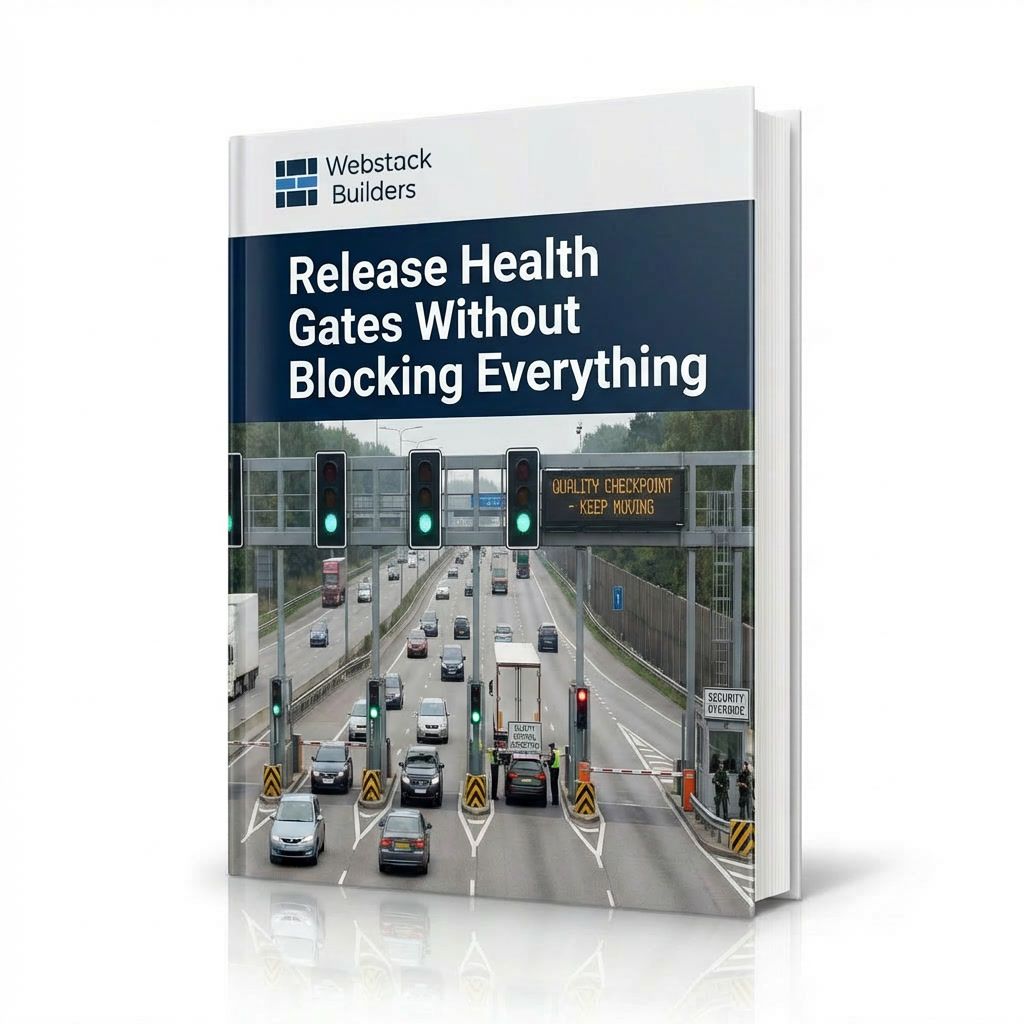
Automated quality gates that catch real failures without becoming a bottleneck or a source of false positives.
- File type
- PDF Download
- Pages
- 22 pages
- File size
- 1.1 MB
Quality gates exist to catch bad deployments, but gates too strict become the biggest obstacle to velocity. A team implemented full-stack gates: tests, coverage, security, performance. After a month, exceptions accumulated — a scanner vulnerability flagged from 2019, coverage dropped 0.1%, cold-start performance triggered. The gate configuration had so many exceptions it caught nothing. They rebuilt with required gates (critical tests, CVE 9+) and advisory gates (coverage trends, performance baselines). False positives dropped 90%, and when required gates fired, people investigated because they trusted the signals.
The measure of a good gate isn’t deployments blocked — it’s real incidents prevented relative to good deployments delayed.
This complete guide teaches you:
- Gate design principles: actionability, determinism, speed, and proportionality
- Gate categories: required blocking, required advisory, and optional
- Anti-patterns: coverage absolutism, flaky E2E tests, and security theater
- Measuring gate effectiveness: precision, recall, false positive rate, and bypass rate
- Progressive delivery gates: canary, shadow, and staged rollout validation
- Post-deployment validation: production traffic analysis and error rate thresholds
- Bypass mechanisms: emergency procedures and audit trails
Download Your Release Quality Gates Guide now to catch real failures without blocking legitimate deployments.
Instant Access
Get The Ebook
Fill out the form below to receive your pdf instantly.