
Rate Limiting Done Right: Protecting Users From Yourself
Free Download
Get the ebook instantly. Review the outline, enter your work email, and open the download in one step.
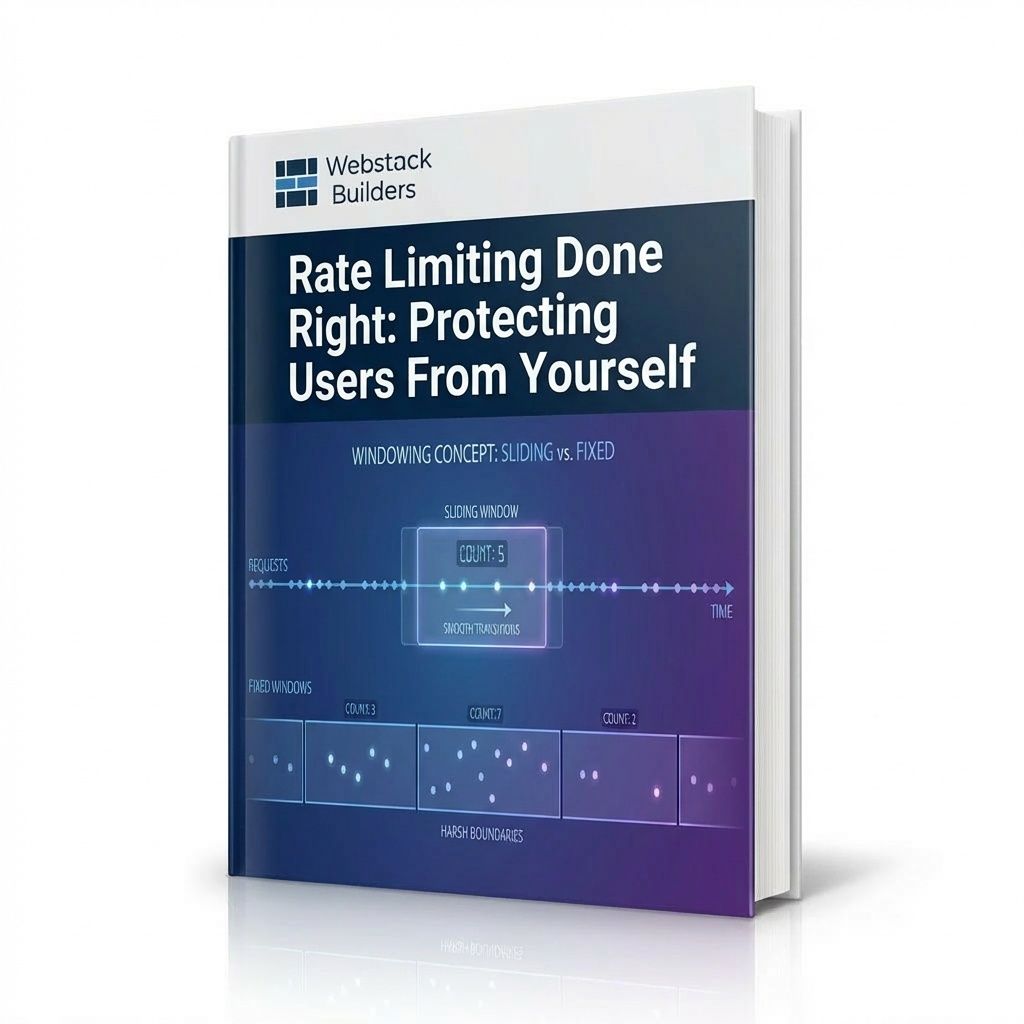
How to implement rate limits that prevent abuse without accidentally blocking legitimate traffic during spikes.
- File type
- PDF Download
- Pages
- 23 pages
- File size
- 1.2 MB
Rate limiting is a double-edged sword. Done right, it protects systems from overload and abuse. Done wrong, it becomes a self-inflicted outage. A company implemented per-IP rate limiting at 100 requests per minute to prevent scraping, but five hundred employees behind corporate NAT couldn’t use the service. After switching to per-key quotas, a viral traffic spike triggered fixed-window boundary problems — 90% of requests rejected at minute boundaries. They switched to sliding window counters with token bucket for burst handling. Same spike, smooth distribution, full service capacity.
Rate limiting isn’t about saying “no.” It’s about saying “not yet” while maintaining quality for everyone.
This complete guide teaches you:
- Rate limiting purposes: resource protection, fairness, abuse prevention, and cost control
- Fixed window, sliding window, token bucket, and leaky bucket algorithms
- Burst handling: why fixed windows fail during traffic spikes
- Implementation patterns: per-IP, per-key, per-user, and tiered rate limits
- Where to limit: API gateway, application layer, and database query throttling
- Communicating limits: headers, status codes, and retry-after guidance
- Distributed rate limiting: coordinating limits across multiple servers
- Testing and tuning: finding limits that protect without rejecting legitimate traffic
Download Your Rate Limiting Implementation Guide now to protect your systems while handling legitimate traffic bursts.
Instant Access
Get The Ebook
Fill out the form below to receive your pdf instantly.