
Monorepo Release Engineering: Affected Builds
Free Download
Get the ebook instantly. Review the outline, enter your work email, and open the download in one step.
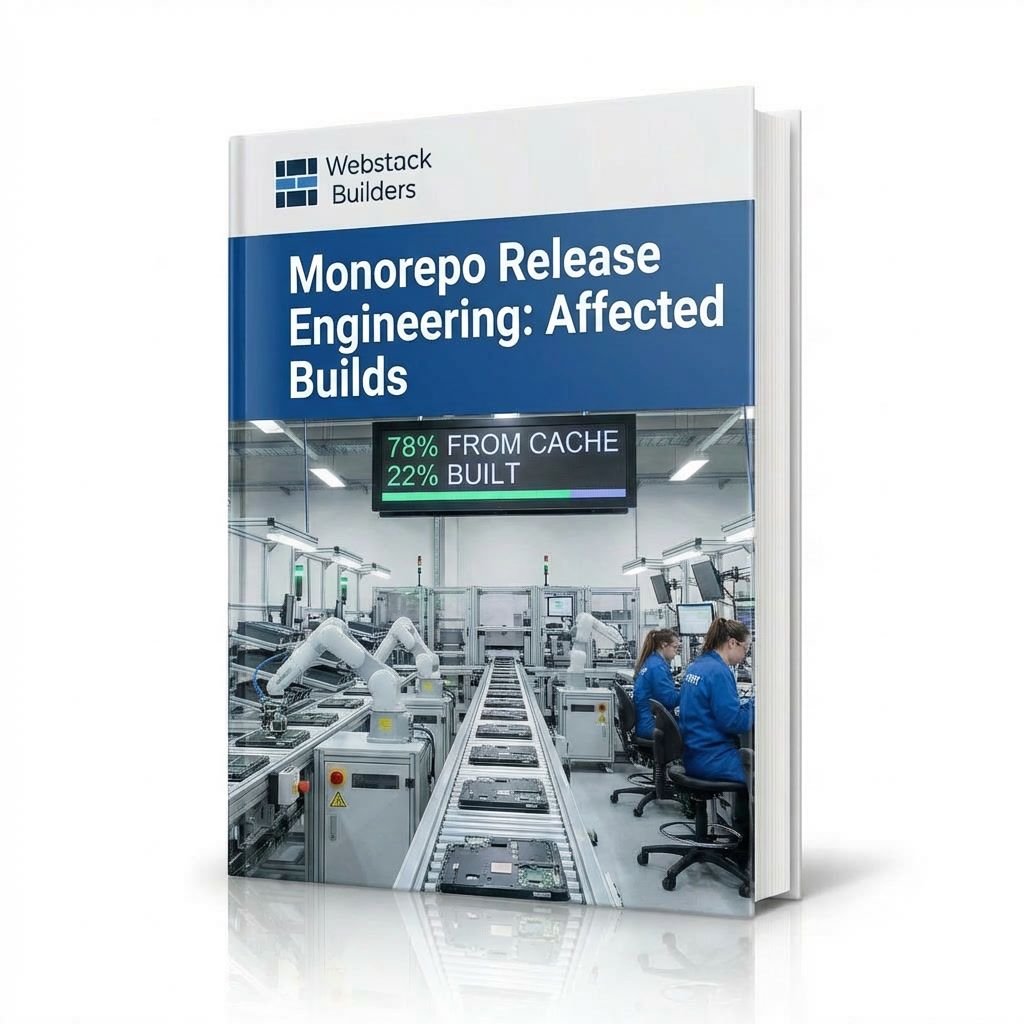
Building only what changed with affected-based builds and remote caching that actually speeds up CI.
- File type
- PDF Download
- Pages
- 27 pages
- File size
- 1.3 MB
Every monorepo reaches a breaking point: a repository that started with 10 packages and a 5-minute CI pipeline grows to 150 packages with 45-minute PR validation. The instinct is to throw hardware at the problem, but a 200-package monorepo building everything on every commit will always be slow. The real solution is building less — figure out what changed, determine what depends on it, skip everything else. Affected-based builds analyze dependency graphs to identify which packages need rebuilding. Remote caching stores build outputs so identical work never runs twice. Together, they provide order-of-magnitude improvements instead of linear parallelization gains.
Cache hit rates reach 85%, build times drop dramatically, and developers iterate in small increments rather than batching changes.
This complete guide teaches you:
- Dependency graphs: package dependencies, transitive relationships, and rebuild impact
- Affected calculation algorithm: mapping changed files and reverse graph traversal
- Remote caching: shared build artifacts across machines and CI runs
- Cache invalidation: when to rebuild despite existing cache
- Tool comparison: NX, Turborepo, Bazel, and language-specific build systems
- Implementing affected builds: minimum configuration and quick wins
- Cache hit optimization: file hashing, content addressing, and TTL strategies
- Debugging cache misses and unexpected rebuilds
- Security: controlling cache access and artifact validation
Download Your Monorepo Build Optimization Guide now to eliminate wasted CI time and accelerate feedback loops.
Instant Access
Get The Ebook
Fill out the form below to receive your pdf instantly.